Your cycle, from your own temperature: what basal body and skin temperature show
Quick answer
Basal body temperature, your temperature at complete rest, rises by about 0.2 to 0.6°C after ovulation and usually falls again before your period. Skin temperature measured at night by a ring or wrist device follows a similar pattern. The change is small, so it only shows clearly over weeks, compared with your own usual.
Key takeaways
- Basal body temperature rises by a few tenths of a degree Celsius after ovulation and usually falls before the next period.
- Studies of rings and wrist devices worn at night find a similar rise in skin temperature in most cycles.
- One night tells you very little; illness, alcohol, short sleep and a warm bedroom all move the reading.
- A temperature rise shows that ovulation has probably happened; it does not predict it on its own.
- Temperature from a consumer wearable is not a method of contraception.
What is basal body temperature?
Basal body temperature is your temperature at complete rest. Traditionally it is taken by mouth first thing in the morning, before you sit up, talk or drink anything. People track it because it changes in a regular way across the menstrual cycle.
The change is small. Cleveland Clinic describes a rise of about 0.4 to 1°F after ovulation, which is roughly 0.2 to 0.6°C. That is less than the difference between a cool night and a warm one, which is why a single reading tells you so little and a pattern over weeks tells you much more.
How does temperature change across the menstrual cycle?
A menstrual cycle runs from the first day of one period to the day before the next. The NHS says most cycles are around 28 days, and that anything from 21 to 35 days is common. Our guide to the four phases of the menstrual cycle explains each stage in full.
Temperature follows the cycle in two broad halves:
- Before ovulation, in the follicular phase, your resting temperature sits at its lower level.
- After ovulation, in the luteal phase, hormonal changes lift it slightly. It stays higher for the rest of the cycle.
- Before your period, if you are not pregnant, it falls back again. If you are pregnant, Cleveland Clinic notes that it stays raised.
Ovulation is when an ovary releases an egg. The rise in temperature comes after it, which matters for how you read the pattern: temperature can show that ovulation has probably happened, but it does not warn you in advance.
Is skin temperature from a ring the same as basal body temperature?
Not quite. A thermometer in the mouth measures temperature inside the body at one moment. A ring or wrist device measures the temperature of your skin, many times through the night, while you sleep. Skin temperature is a different number, and it moves more with the room around you.
The research suggests the cycle shows up in it all the same:
- A 2018 study in Bioscience Reports followed 136 women wearing a wrist sensor at night, across 437 cycles. A sustained three-day rise in skin temperature appeared in 82% of cycles. On average, early luteal phase temperature was 0.33°C higher than in the fertile window. The authors also found the readings were not thrown off by alcohol, sex or eating before bed, which can upset a morning thermometer reading.
- A 2019 pilot study in BMC Women’s Health gave 22 women a ring that measured finger temperature at night for an average of about 115 days. In 21 of the 22, temperature differed between the two halves of the cycle by the study’s set threshold of 0.15°C.
- A 2024 study in the Journal of Biological Rhythms looked at 120 women using a ring in daily life. Skin temperature rose by 0.3 to 0.7°C after ovulation compared with before it, following a smooth wave rather than a sharp step.
These are small studies, and each used particular devices. They show that nightly skin temperature carries the shape of a cycle. They do not show that any one device can date ovulation precisely.
Why does one night tell you so little?
Because many things move your temperature by as much as the cycle does. Cleveland Clinic lists breastfeeding, alcohol, fever from an illness, not getting enough sleep, stress, some medicines and travelling across time zones. The 2024 study adds the room itself: ambient temperature and humidity, and the way you slept.
A single warm reading could be the start of the luteal phase. It could also be a cold coming on, a late heavy dinner, or an air conditioner that switched off at 3am. Over two cycles or more, the pattern stands out from these one-off nights. That is why a temperature trend is compared with your own usual, not with anyone else’s.
Does the Gulf heat change temperature readings?
Hot weather changes the conditions your skin is measured in. The 2024 study lists ambient temperature and humidity among the factors that affect nightly skin temperature.
In a Gulf summer, the air conditioning decides the temperature of the room you sleep in. What matters is that the room is similar from night to night. A bedroom set to the same temperature each night gives your own pattern the best chance to show. A night on the sofa with the window open, a power cut or a hotel room will show up as noise.
Heat also affects sleep itself. Our guide to sleeping through a Gulf summer covers what helps, and what 46 degrees does to you explains how the body handles extreme heat by day.
How to read your own temperature pattern
- Wear your ring or band every night. Gaps make the pattern harder to see.
- Keep the room similar. Set the air conditioning to the same temperature each night where you can.
- Note the unusual nights. Illness, travel, alcohol, a late meal or a very short night all explain a jump.
- Mark the first day of each period. It anchors the pattern to your cycle.
- Look across two or more cycles. The shape becomes clearer with each one.
- Compare with your own usual. Your levels are your own; another person’s numbers mean nothing for you.
- Take any worry to a doctor. A pattern that changes and stays changed is worth a conversation.
Can temperature tell you when you ovulate?
Only after the fact, and only roughly. Because the rise follows ovulation, a temperature chart confirms that ovulation has probably happened in that cycle. Predicting the next one relies on your past cycles being regular, and Cleveland Clinic notes that the method is not accurate if your cycles are irregular.
This is also why temperature from a wearable is not contraception. The NHS says fertility awareness methods are 91 to 99% effective when taught by a trained professional and followed exactly, and about 76% effective when they are not. Those methods combine temperature with other signs, such as changes in vaginal discharge and cycle length. If you are trying to conceive or trying to avoid pregnancy, speak to a doctor.
Why track the pattern at all?
For many women, the value is simply knowing their own body better. A temperature pattern that repeats month after month is a quiet confirmation that the cycle is following its usual rhythm. A pattern that changes, such as cycles that grow much longer or shorter, or a rise that stops appearing, is useful to bring to a doctor, together with the dates of your periods.
It also puts other readings in context. A second 2024 study in the Journal of Biological Rhythms followed 96 women aged 18 to 55 wearing a ring. Heart rate was higher around ovulation and in the second half of the cycle than during the period, and in the younger women heart rate variability dipped in the days before the period. Sleep length did not change across the cycle. Knowing where you are in your cycle can put a slightly higher heart rate in the week before your period into context.
Common mistakes
- Reading one night as a verdict. A single high number is more likely noise than news.
- Comparing with someone else. Resting temperatures differ between people. Only your own pattern counts.
- Forgetting the room. A warmer or cooler bedroom moves skin temperature.
- Ignoring illness. A fever lifts temperature for days and can hide or mimic the cycle’s shift.
- Treating a wearable as a fertility test. It shows a pattern; it does not replace medical advice or contraception.
When to see a doctor
The NHS advises seeing a doctor if:
- you have missed three periods in a row and a pregnancy test is negative,
- your periods have not started by the age of 15,
- your periods become irregular or change significantly,
- you bleed between periods, after sex or after the menopause,
- you have missed a period alongside other changes such as weight gain or loss, tiredness, new facial hair, or dry or oily skin.
A fever that does not settle, or any change that worries you, is also a reason to speak to a doctor.
Where Sisly fits
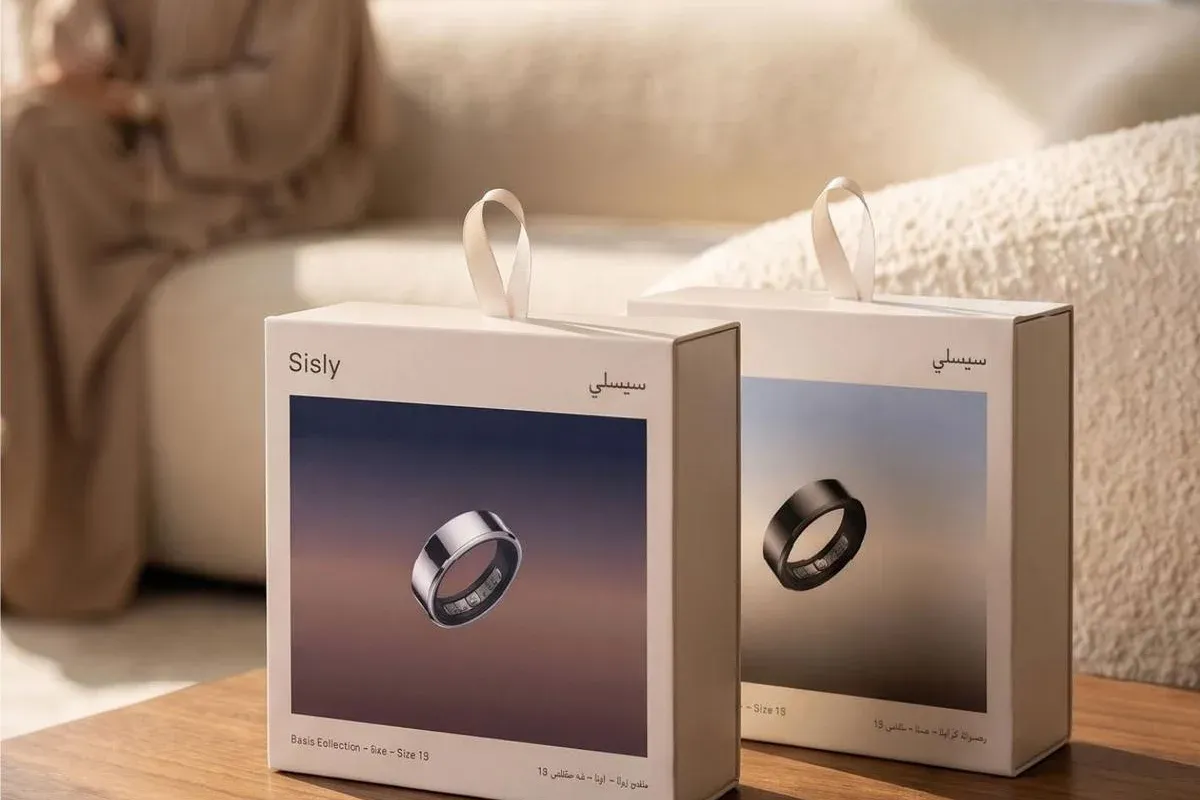
Sisly is a titanium ring or band that reads your sleep, energy, stress, heart rate variability, activity and skin temperature, each against your own normal. Your readings are hosted in the UAE, and the app is in Arabic and English. Sisly is not a medical device. It shows how your skin temperature moves from night to night compared with your usual, and it leaves the conclusions about your health to you and your doctor.
For more on reading the body at rest, see our guide to listening to your resting heart.
Questions, answered
- How much does body temperature rise after ovulation?
- Cleveland Clinic puts the rise in basal body temperature at about 0.4 to 1°F, which is roughly 0.2 to 0.6°C. It usually stays higher until shortly before your next period. In a 2018 study of wrist skin temperature at night, the early luteal phase averaged 0.33°C higher than the fertile window.
- Can a smart ring tell when I ovulate?
- A ring can show a rise in skin temperature that usually follows ovulation. A 2019 pilot study of 22 women found that finger temperature at night differed between cycle phases in 21 of them. The rise comes after ovulation, so on its own it confirms rather than predicts. It is not a contraception method.
- Is skin temperature the same as basal body temperature?
- No. Basal body temperature is traditionally taken by mouth on waking, before you move. Skin temperature is measured on the finger or wrist through the night. The two are different numbers, but research shows that nightly skin temperature rises and falls across the cycle in a similar pattern.
- Why is my temperature higher before my period?
- After ovulation, hormonal changes raise your resting temperature slightly for the rest of the cycle. If you are not pregnant, it usually falls again shortly before your period starts. If it stays raised, a pregnancy test can help, and a doctor can explain what else might be going on.
- Does the heat in the Gulf affect temperature tracking?
- It can. A 2024 study of nightly skin temperature named room temperature and humidity among the factors that move readings. A bedroom that is much warmer or cooler than usual can shift a night's number. Keeping your room at a similar setting each night makes your own pattern easier to see.
- Can I use temperature tracking to avoid pregnancy?
- Not from a consumer wearable on its own. The NHS says fertility awareness methods are 91 to 99% effective when taught by a trained professional and followed exactly, and about 76% effective otherwise. They combine temperature with other signs. Speak to a doctor about contraception that suits you.
- When should I see a doctor about my cycle?
- The NHS advises seeing a doctor if you miss three periods in a row with a negative pregnancy test, if your periods become irregular or change a lot, or if you bleed between periods, after sex or after the menopause. Do the same if your periods have not started by 15.
This article is general information, not medical advice. Speak to your doctor before changing your diet or exercise.
Sources
- Cleveland Clinic, Basal body temperature ·
- Shilaih et al., Modern fertility awareness methods: wrist wearables capture the changes in temperature associated with the menstrual cycle, Bioscience Reports, 2018 ·
- Maijala et al., Nocturnal finger skin temperature in menstrual cycle tracking: ambulatory pilot study using a wearable ring, BMC Women's Health, 2019 ·
- Gombert-Labedens et al., Using wearable skin temperature data to advance tracking and characterization of the menstrual cycle in a real-world setting, Journal of Biological Rhythms, 2024 ·
- Alzueta et al., Menstrual cycle variations in wearable-detected finger temperature and heart rate, but not in sleep metrics, in young and midlife individuals, Journal of Biological Rhythms, 2024 ·
- NHS, Periods ·
- NHS, Stopped or missed periods ·
- NHS, Natural family planning (fertility awareness) ·